Friday, November 7, 2008

PASSAGE TO EDEN


Cruise to Eden

Our ship set sail towards the Indian Ocean, then picked up north westerly heading over the Arabian Sea. We continued with our training as well as performing ship’s duties such as keeping watch on the bridge and celestial navigation. The journey was approximately 7 days over the vast blue ocean.

Deck Volleyball


The sea was kinder to us on this leg as there was no storm. Some days the weather was almost perfect. Our ship XO organised deck volleyball on the ship maindeck. A long rope was stretch from the bow to the bridge. Then the volleyball was hung from this rope to prevent it going overboard. We really enjoyed the game and can get pretty competitive at times but it relieved boredom and also brought us some sense of normality. See photo above.


Land Ahoy!!!


Once again, we spotted landfall. The dark grey mountains appeared clearer and bigger as we approached the Red Sea. Eden is the capital of South Yemen. The harbour pilot guided us to our anchorage point. We did not have permit to enter the harbour. Instead the ship anchored a few miles off the coast. From here, we utilised the ship’s smaller boats, LCVP (Light Craft Vehicle and Personnel) to ferry ship’s personnel to and fro harbour. The Midshipmen were tasked with this duty. I was also part of the training.

Boat Handling

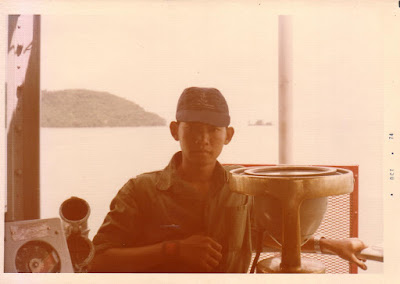
The LCVP had to be lowered to the sea with the derrick cranes. Boat handling was part of our training. We took turn to do ferry runs to and fro harbour under the watching eyes of the boat sergeant. The LCVP was armoured plated, designed to carry marines and light vehicles from ship and beach on land. It was fun and thrilling driving this boat. Coming alongside the jetty or shipside required judgement, some skill and experience. (That's me handling the boat)


Skin completely burnt

Over the month, I had so many sun burns until I had no more skin left to be burn. I was born dark and now become darker. Under the intense heat in the Middle East and the hot sun, I was now completely blackened. I wondered if my family and friends could recognise me. I had lost some weight too and now even more skinny.


--------------------------------------------

Wednesday, November 5, 2008

COLOMBO, SIGHTSEEING

Pick pocketed and cheated


The city is within walking distance from the harbour. We moved around in groups. There were streets urchins and men following us, some selling souvenirs, stamps and some changing money. I felt rather irritated and became distracted by the constant touting and harassment. My favourite Parker pen was picked. One of them who had been trying to sell me stamps, pasted on a thin cardboard must have hooked it away with this thin cardboard. I was also cheated US$10. Because I was tempted by the superior exchange rate I was tricked. I was asked to place my money in an envelope he gave me. He sealed the enveloped, returned it to me and asked me to wait while he looked for his boss. Of course he never returned. It was a classic case of ‘envelope switching’ which I learned later. I was naive but I was glad I learnt my lesson early. This lesson augurs well for me as I am to travel extensively in my adult life. It was a real time lesson for street-wisdom.

The city of Colombo


The city was the capital of Ceylon (today called Sri Lanka) with 2 or 3 storeys colonial styled buildings, somewhat similar to Singapore. The streets were rather dirty and the places were crowded with people. Many of them were just wondering around aimlessly. Not to mention, there were also many beggars. Some people just stared at us. English was the widely spoken language. The local spoke Tamil and Singhalese. Like a birds out of the cage, we just went wild shopping. Basically we wanted to buy souvenirs. I bought a black iron-wood book stand, crafted with elephants and till in good condition till this day, after more than 30 years. There were many gems shops dealing with semi-precious stones like topaz, sapphires, cat-eyes and rubies which I did not buy. I had a big meal of jumbo crabs with my friends at Nanking Chinese Restaurant.

Like a tourist

We snapped many photograph of Colombo. See below.


Kandy

A tour was organised for the midshipman to visit the city of Kandy. It was situated north and centre of the island. It is the cultural capital of Ceylon and house many temples, both Buddhist and Hindu. It was a centre for local art and crafts. I couldn’t remember much of what I saw during the tour. Nevertheless, the journey up there was still educational and relaxing especially having been on the high seas for more than a week.


We spend a few more days wondering around the streets of Colombo. In between, we had to do sentry duties on board as well as the usual chores of washing clothes and packing our sleep area.

Goodbye to Colombo

Our ship left Colombo after one week. Our next destination was Eden. Besides midshipman training, the navy had a secret mission to accomplish in this socialist country call Yemen.


--------------------------------------

Tuesday, November 4, 2008

COLOMBO, CEYLON


Training never stop

I had been a momentous 7 days on the high sea and was really a humbling experience for most of us, 18 years old, we were neither kid nor grown-up. After the storm, we all had ‘grown up’ a little bit. We missed the comfort of home and really appreciated the calmer sea. While the living condition was not that great, we enjoyed the company of friends. There were some pressure while on training as we had to attend lessons, understudy the duties of various naval officers. We were rostered watch-keeping on the bridge as well as spending time in the engine room. We took it on our strides and not succumb to pressure as we were constantly appraised by our officers to judge our suitability to make the grade of naval officers.

Entering the Harbour

By the 8th day at sea, we were anxiously awaiting for landfall. It’s a kind of kid excitement; nevertheless I thought it very human. It has been ‘water, water, water everywhere’ so the first sighting of land got the whole ship excited. Man, we were going to walk on land again!
Approaching the Harbour
Harbour Duties

The ship was met by harbour pilot who guided her into Colombo harbour. The crows and albatross were circling all over the ship. We took up duties manning the fenders and ropes as the tug boat berthed us alongside the wharf. There were hives of activities on the main deck as sailors secured the ship for the layover. Such as lowering the gantry and setting up the guard rails and erecting the guard post for guards. The ship needed to be tidy up as we foreign naval officers and visitors and all deck equipment must be properly stowed. As midshipman we were tasked to assist the officer to maintained security. Sentries were to book sailors out and salute any officer boarding and disembarking the ship.


The colombo harbour


First step with the sea leg

The navy call it shore leave. It means off day at specified times. For midshipmen, dress code remained long sleeves with ties. The weather was similar to Singapore, hot and humid. The first few steps on ground, we felt a bit apprehensive. We have been balancing each and every step while on board the ship. Now it was almost surreal that the ground was just too calm. As I have mentioned earlier, this was a good bargain for NS. 5 days free holiday in Ceylon. A trip had been planned for us to go up-country to the ancient capital city of Kandy.


Walking to the city of colombo


---------------------------------------------

Sunday, November 2, 2008

CELESTIAL NAVIGATION

Ever wonder how the earlier mariners sailed around the world, discovered new territories and yet able to return home without being lost. Here's the answer.

CELESTIAL NAVIGATION

Since time immemorial, human race has been finding their way from the heaven, following the heavenly bodies that never fail to appear at the onset of darkness. Many of the stars have Arabic names because the people of the desert used them for direction and later on did the mariners across the sea and ocean. Celestial Navigation is the art as well as a science of navigating by the stars, sun, moon and planets. Of course, with the inventions of electronic and radio, it loses its importance. More so today, the uses of GPS from satellites have assigned this form of navigation to history.

The concept

The stars are very distant from the earth. As a result it appeared constant and can be spotted at the same place every night. Just like the sun, we know where it will rise and the inclination at a certain time. But as the season changes, some shifts can be expected. As time changes, so do the inclination from the earth. In another word, one can predict that a certain star almost accurately its bearing and inclination at a specified time. Astronomers and mathematicians thus were able to work out a table to infer position from the bearing, inclination and times of the stars. The tables are call the ‘nautical almanac’ and ‘sight reduction table’.

Shooting the stars

Before we used the marine sextant to measure the inclinations of selected stars, one has to do his homework to find out what stars were visible from the ship's position together with the anticipated bearing(azimuth) and inclination(altitude). Good choice should be stars that were easily recognised and shots taken from different directions of the ship. Mariners were limited to dawn and twilight to take shots. At these times, both the horizon and only the brightest of star become visible and identifiable. The sextants measure the altitudes of the stars from the horizon. Precision timing to the nearest second must be noted at the time the ‘shot’ was taken. 3 stars altitudes were needed to get a ‘fix’ or position. Of course, the moon, planets and the sun at noon where it was at its highest point were also used to obtain position lines.

Plotting the position.

Once the readings were taken, it’s back to the chart table to complete a complex set of calculations to determine position lines. Initially we were completely lost when we can’t even get one position line to plot on the chart. As time went by, we improved and learned from mistakes. Till this day, I still remembered a quotation on the nautical almanac. It read, “MAN IS NEVER LOST, ONLY TEMPORARILY MISPLACED”. It has since been adopted as my personal life philosophy.

Meridian Passage.

The aim is to find the sun highest altitude at around noon. After a set of calculation, a mariner can now determine the ship latitude. In layman term, how far is the ship away from the equator.

My greatest respect for the ancient mariner

Having gone through this training, I now realised how brave and courageous the ancient mariners were. Depending only on wind to sail with compass, inaccurate sextants, and rudimentary tables, they were able to navigate around the world. Of course many were lost and shipwrecked. Nevertheless, thesa pioneera were precursors to modern day electronic navigators like the INS and GPS. First the sailing yacht, the steam engines and then the diesel engines and eventually modern aviation. Without the knowledge of navigation, we could never find our destinations across the ocean and the land mass.


-----------------------------------------------------------

Saturday, November 1, 2008

THE SEA TRAINING


Lesson Plan

The purpose of this training was to expose us to maritime operations. It allowed us to put into practice all that we had studied in classroom during the last 6 months. This was especially so for seamanship and navigation. The sea training was also to give us greater appreciation and awareness of the duties of the sailors.

We had to spend time in the engine room, operate electronic and communications equipment as well as the ship radar system. One of the most tiring jobs was ship maintenance. This included chipping away the rust, paint with red oxide followed by another layer of paint. Painting shipside requires the use of hanging (Boson) ladder. We were taught on handling the ropes and fenders when the ships enter or leave the harbour.


People skill

The ship environment is very different from that of the army. Here everyone is sort of a specialist and almost indispensible. Interpersonal and communication skill are very vital to get the ship's crew to accomplish a mission. The leadership skill of the naval officer is very different from that of an army officer. We were taught to be humble and learn as much as possible from the experience sailors. Not only did we learned a lot, but also earned their respect. Ironically, someday we became their boss.

Weather and the Environment

We had been baptised by the storm at the Bay of Bengal and successfully 'commissioned' our sea legs. This part of the training can never be simulated in the classroom. We had learned to appreciate the wind, rain and thunderstorm in the ocean, the darkness in the empty ocean at night. The high wave and the monster swell were a lesson of humility and opened our eyes to the power of nature. We learned to be safe and make the necessary adjustment and adapt according to the changing environment. One of the biggest lessons I learned was to be ‘ship shape’. It simply means to be prepared and ready for any impending adverse weather or any unforseen situation. This applies to our daily life.

Understudy the ship’s officer

Watch keeping was another part of the job training. Here we learned from the experience officer the essential of keeping the ship safe and avoiding collision. Rules of the Sea must be observed. Some of the seasoned officers were really tough and asked a lot of questions. But we learned despite being humiliated at times.
Each watch was 4 hours. The most tiring watch was the from midnight to 4 in the morning. The 'OOW' or officer of the watch has 2 lookouts and l radar operator. Captain of the ship never kept watch; he is only on the bridge when the ship leaves and enters harbour or in emergency. Up on the bridge can be very boring but can also be a serence and peaceful place for time to reflect, especially during dark night filled with stars while the ship sailed through the calm sea.


Communication

The ship was equipped with all kind of communication equipment from VHF to HF. Besides using electronic, the navy ship also communicates using light and flags when in close range to prevent enemy interception. We learned to send and receive messages through flashing lights. The use of Morse-code on the radio set was beyond us. But we need to memorise all the flags that represent each alphabets and numerals. These were normally used to identify or represent the ship’s status when operating in a fleet.

Celestial Navigation

The major exercise was celestial navigation. It was a bread and butter subject for naval officer whether in the military or merchant navy. 3 times a day, dawn, noon and dusk, we had to use the marine sextants to ‘shoot’ the stars, moon and sun to obtain their inclinations from the horizon. Then we went through a set of calculation to determine the ship’s position. More details on my next blog.


------------------------------------

Wednesday, October 29, 2008

1ST LESSON. POWER OF NATURE

Goodbye to calm sea

The sea was generally calm as we sailed through the Straits of Malacca. As we approached the tip of Sumatra, I could feel the slight gentle roll of the ship. I observed some swell on the sea. A little balancing was required. The old sea hands had mentioned about ‘sea legs’. Some birds were still flying around especially at the ship stern. There were still some ships in sight.

The emptiness of the vast ocean.

As the ship passed the northern tip of Sumatra, she turned port on westerly heading towards Colombo. The land disappeared from the horizon as the ship entered the Bay of Bengal. For the first time in my life, I understood the meaning of the emptiness of the vast ocean. I thought of those brave ancient mariners who sailed into the unknown. All they had were some rudimentary navigational equipment but abundant of courage and hope to fulfil and prove the theories were correct.


2nd day Bay of Bengal.

The sky was overcast with grey clouds and the ship sailed alone in the Bay of Bengal. The sea swell had become larger with ‘white horses’ and the ship rolled even more. Not only that, when it hit a big swell, the ship pitched up and down. Increasing, it became difficult to walk on the deck without the balancing act. My stomach was upset and loss my appetite completely. The discomfort get worst by the hours. Soon, I was running to the heads to puke. I lost count of the number of times I puked. I wasn’t alone suffering. Most of my mates suffered the same fate and wondered why we choose the navy to suffer.


Cure for sea sickness.

My Inche assigned us ship duties to keep us mentally and physically occupied. He told me that I must continue to eat even if I was going to puke. As I was helpless, I took his fatherly advice. I ate and puked. The sea conditions got worst and there was also rain. The ship rolled as much as 30 degrees on both side and the pitching become more violent each time when the bow hit big waves. Staying in the cabin was the worst. The best place was to remain on the main deck with fresh air. Some of my colleagues were now totally a mental wrecked confined to the bunk listlessly. I continue to stay and did my assigned duties, ate and puked. The feeling was really terrible and really regretted joining the Navy.

3 days of puking

Yes, I puked for 3 full days and then miracle happened. The sea sickness just left me and I was back to my old self. Most of my peers too recovered. In spite of the pitch and roll, I realised I had found my 'sea legs'. I never got sea sick again in my entire NS. By now I could console my sea sick friends and also disturbed one very arrogant mate who used to boast of his martial arts experience. I remembered teasing him and he begged me not to disturb him. Sea sickness is such a helpless ordeal. Going through it was like the end of the world. There was no escape from the high seas. This compound the mental agony of helplessness.

The Ocean

By now, I was able to appreciate the vastness of the ocean as well as the power of nature. At night, I could see more stars than anytime I had at home. On board the ship, I appreciate how important each crew was to the ship. Working in cramp environments especially getting to the engine room through the shaft was dangerous. At night, if any crew fell overboard, it was as good as saying permanent goodbye. So it was very important for the crew to observed safety seriously and looking after one another. As officer, the safety of the ship and crew are paramount with no compromise. That was the training and exposure we the midshipmen were supposed to appreciate and learn.
------------------------------------------------

Saturday, October 25, 2008

SEA CRUISE TO EDEN

The Ship Set Sail on Sept 1974

All the final preparations were completed. The ship was commanded by Major Raju and the XO (Executive Officer) was a season merchant navy officer Cpt Anthony Chan. The ship slipped off Bedok Jetty and all of us were lined up on the main deck for the traditional naval ceremony when a ship leaved harbour.

As we sailed into the Straits of Singapore, we were met by PC and MGB as ascots sailing along side this grand old dame. As they came abeam us, they gave the traditional naval salute by ‘piping’ and lowering the flag as a mark of respect to the ‘senior’ ship. By protocol, Endurance had to reciprocate the same gesture. The navy have a lot of naval traditions, naval terminology and jargon. Naval officers take all these very seriously and they take immense pride of this heritage. In Britain, the Navy is the lead service and all royals had to go through naval training.

(Left and below, escort ships at the Southern Islands)


Moment of Excitement

The ship sailed through the Singapore Straights, passing St John Island, then the Raffles Lighthouse and after passing the Sultan Lighthouse entered the Straits of Malacca. The sea was calm and the scenery was great. On the starboard (right) side was Malaysia and on the port (left) was Sumatra. I had a lot of great expectations from this trip. I know I will return to tell many exciting stories to my friends. Many of us midshipmen was just thinking and wondering, what a bonus for NS boy! Fully paid cruise for 2 months. We were all eager for the adventures.

Our home in the sea

As midshipmen, we were accommodated in the aft mess rigged with 3 tiers bunks. This was our home for the entire 2 months of this training cruise. The aft mess was designed to carry army troops. Behind the bunks were the heads (toilets) and showers. It was really cramped and when the air conditioning broke down, this place became a sauna. Nevertheless, we adjusted well and that how sailors developed strong bond, learning to share, give and take, living in compact space, literally rubbing shoulders
every day. (Left--- Mess for dining and homework, Below, Bunks)


Engine Trouble.

One day after setting sail, the ship developed engine trouble and needed to returned to port for immediate repairs. It took 3 days for the repair work and we were given permission to return home but I choose to stay onboard. Going home was inconvenient for me and may raise unnecessary anxiety for my parents.

Sail Off Again

This time no fanfare and we slipped away quietly. By then we were also quiet familiar with the ship and had settled down to the ship's routines. Everything was peaceful until we entered the Bay of Bengal, just north of Sumatra.


--------------------------------------------

Wednesday, October 22, 2008

Midshipman Sea Cruise

Bedok Jetty

RSS Endurance was berthed at UMPCJetty, now known as Bedok Jetty. In those days, the east coast was just reclaimed and the surrounding area was muddy during rain. The area was isolated and trees and wild shrubs grew. To access the jetty, we had to walk along dirt road with no lighting. After disembarking the bus at marine parade, just off Nallur Road, I had to make the 10 minutes trek hauling my bag with all my personal items for the 2 months cruise.

History of RSS Endurance (LS201)

Previously known as USS Holmes County (LST836). It’s a Landing Ship Tank designed to carry troop and tanks with beaching capability and operate in shallow water. This ship was launched on 29 Oct 1944. She served in the US Navy during WWII, Korean War and Vietnam War and was decommissioned in 1971. She was transferred to Singapore Navy on 1 July 1971 at a nominal fee and renamed RSS Endurance (LS201). RSN assigned her callsign A82.

Ship Specifications

The ship has a displacement of 4000 tons. Its length was 328 feet, beam 50 feet and draft between 3 to 10 feet depending on the operation it was engaged. It had a maximum speed of 12 knots and endurance of 24.000 miles. It has two boats (LCVP). The ship has payload of 1900 tons. She had a tank deck and main deck. It has a bow door and bow ramp to facilitate movement of vehicles into the tank deck and main deck during beaching operation. It has many ballast tanks and almost flat heel to enable the ship to beach in shallow water. The ship has 2 forward and 2 aft 40mm Bofor Anti-aircraft guns as its main armament. The ship was propelled by two 900 hp diesel engines, with two shafts and twin rudders.

RSS Endurance beached at East Coast Park

------------------------------------

Tuesday, October 21, 2008

NAVY - OTHER ACTIVITIES

Monthly Functions

Each month a social function was planned. The purpose was to promote social grace and skill as well as developing and improving planning and organising skill. The school also organised a formal dinner where we had to dressed up either formally or in full military uniform. We also had crashed course on etiquette, how to drink and eat gracefully and talk politely. To use cutleries and table ware correctly. We had to be accompanied by a female partner too. That was a bit stressful for me as I did not have a steady girlfriend but there were never a problem with girl volunteers. Many seniors officer were invited to these formal functions. Alcohol was served and we had wines and beer.


Other activities included parties. Always, there were more girls available. I too had no problem bringing a few.

Outdoor activities

We were taught sailing the yacht. The training school also had a whaler which required a 12-man crew to row with very heavy oars. We tooks turn to be the coxswain to command the rowing, with proper commands used adopted from the Royal Navy. There was also a round the island cruise on the visiting yacht from another country.

Camp at seletar Island

We also had a 2 days camp at Seletar Island over one weekend. We slept in tents, had camp fire and some group activites.


Mast Rigging Display.

On one SAF days, we also participated in a naval mast rigging displays. This involved raising a 30 foot mast completed with rope, lanyards, rigging and accessories. The aim was speed and coordination and to be completed within minutes.

Weekend off

We were dismissed on Saturday for the weekend. As officer to be, we were required to check out of camp with long sleeves and tie. But as soon as were out of sight, the ties disappeared. But on certain weekend, we had to stay back to do guard duties.

Crabs and Rambutans

On one of the weekend, I organised a crabbing session at the jetty with Inche Wee. I provided the nets and baits. We caught lots of crabs and Inche hid the catch in the toilet. He was supposed to bring it home the next day. Somehow the crabs died and the stink filtered out and coincidentally, the CO was doing his round and enquired from Inche Wee where the smell came from and ask him to investigate. I couldn’t hide my glee when I looked at him.

I told Inche Wee I had a rambutan farm at home and wish to give the school a treat. So Inche Wee organised a Land Rover and with a few of my mates, we picked enough rambutans for the entire camp.

Happy Family

In the camp, the midshipmen live like a family. We cooperate and did our duties diligently and never get into trouble. There was hardly any rivalry; instead I felt we bonded very well. During the evening, we chatted and enjoy sharing school experiences. Sometimes, we had sing-a-long sessions with beer provided by our own ‘Midshipman Mess’.

In camp, all three meals were provided. We were served like officers. The quality of food was not great but acceptable. The lectures during the days were conducted at very comfortable pace and there was hardly any night activity. Light out was at 10.30pm and wake up at 5.30 followed by some exercises before breakfast.
Finally, Ready for the Sea

By the end of September, we had completed all the modules. Almost all of us passed the examinations easily the first time. Some of the Chinese educated faced some problems and become more evident. We had a passing out ceremony and dinner to celebrate the end of this phase of training.
Sea Cruise

Our next phase of training was on board the training ship called RSS ENDURANCE. This was to be the most memorable part of my national service.


Sunday, October 19, 2008

NAVY, ACADEMIC PORTION

HAPPY 18TH BIRTHDAY

Mei, you have been my wonderful daughter. You have given daddy a lot of happiness and satisfaction watching you grow up and make my life truly meaningful.


--------------------The blog continues-------------------------------------


Midshipman School

3 months of BMT passed quickly. 40 of us were selected for the Midshipman School, the equivalent of the OCS in the army. The entire training was planned for 15 months. 9 months was for the academic portions. The other 6 months were for attachment to various RSN ships for on the job training. A 3 weeks Outward Bound Course was sandwiched in between. The highlight of the training was a 2 months sea cruise. The 40 of us was divided in 4 divisions, Dragon, Wolf, Tiger and Lion, All were names of existing Navy’s Missile Gun Boats. I was in Tiger Division.

Group photo of Wolf and Tiger Divisions

Midshipman School was staffed by the best officers and NCOs. There were a few expatriate trainers from other navies. They were supposed to impart knowledge as well as skills. As this was the very first course of naval officers to be trained locally, the government would let anything to chance.


Midshipman School Course No 1. 1975
School RSM was like a father

Inche Wee was our RSM. He was responsible for the cleanliness and orderliness of the camp. He was ultimately responsible for all the disciplinary issues. Though he shouted and screamed a lot, he was more a fatherly figure in our eyes. We could talk to him anytime and he also used to tease us.

Course Subjects

The subjects include seamanship, communication, gunnery, radar and navigation. Of all these, navigation was a major subject as we need to understand celestial navigation, the use of stars, sun and moon for ocean navigation. These involved a lot of mathematical computations and calculations extracted from published nautical almanacs. Those were the days before GPS.


An articles from a local newspaper.

Rather easy life

The routine was not very tough. We woke up 5.30 am every morning. This was followed by 5BX and breakfast. Then there was the usual flag raising ceremony. Each day one cadet was appointed as OOD, Officer of the Day, to take charge of the entire group. Classroom work started at 8am and finish by 5pm in the evening. Evening time was normally reserved for homework. The routine was just like school. On weekend we were allowed to go home.
-----------------------------------------